

1936.21.0067
::
netsuke, bältesknapp

- Object description
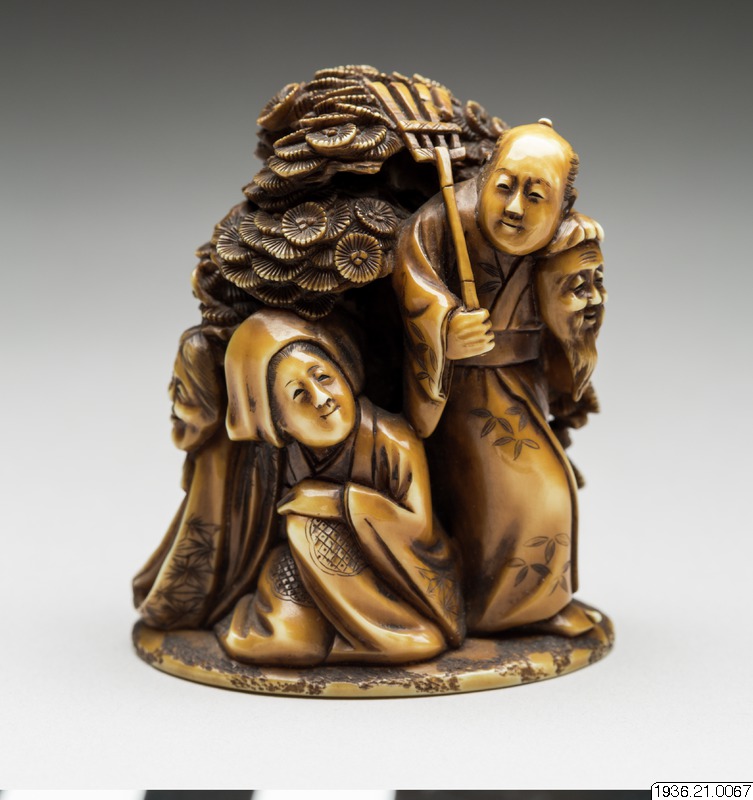
Netsuke föreställande en stående man och en sittande kvinna under en tall, båda hållande masker i händerna. Hans mask visar en gammal man, hennes en gammal kvinna. Dessutom håller han i ett redskap. Hon har ett huckle. På undersidan finns signatur samt två tallkvistar skurna. Motivet föreställer två huvudpersoner ur no-pjäsen Takasago (även benämnd Sumiyoshis gudomlighet) som, eftersom den innehåller gestalter som är gudomligheter, symboliserar bl. a. lycka. I pjäsen finns bl. a. ett äldre par vid en tall, som de krattar marken under. Det är dock egentligen två tallars andar som förkroppsligas av det gamla paret. (Komparu 1983, s. 52). Enligt andra versioner av historien möttes det gamla paret redan som mycket unga och har levt lyckliga ihop hela livet. Efter döden återvänder de till den plats där de levt, vid tallen nära havet.
Kimonon har inga fickor, småsaker kunde läggas i ärmarna och innanför bältet och så kunde man bära olika dosor, pipor och penselfodral på en snodd från bältet. De bärbara sakerna kallas sagemono. Accessoarerna blev särskilt för männen identitetsskapande statusföremål och en viktig del av herrmodet, en egen värld i mindre skala med rika motiv. Olika typer av konstnärligt utformade sagemono är kända fr o m 1600-talet. Förutom tobaksrelaterade dosor är en av de mer kända typerna sigilldosor (inro). Bokstavlig betydelse är en korg (ro) att lägga sigill (in) i. Enligt lag var endast stämplade signaturer giltiga vilket krävde att t ex samurajer och köpmän som hade behov av sigillstämplar fick bära dem med sig i små dosor. Detta var ursprunget till sigilldosor (inro) som snart främst kom att användas för medicinförvaring. Utseendet på accessoarerna varierade efter bärarens smak, ekonomi och modetrender. När västerländsk klädsel med fickor blev populär under Meiji-perioden (1868–1912) minskade behovet av dessa bärbara föremål och de delades ibland upp i sina beståndsdelar (netsuke, s k bältesknappar) för sig och såldes till västerlänningar. (Baserad på text från utställningskatalogen Japan. Föremål och bilder berättar. 2011).
Miniatyrskulpturerna, ofta kallade bältesknappar, (netsuke) rymmer en hel värld att utforska. Myter är ett stort motiv. Ofta var designen lyckobringande och inte minst underhållande.
Netsuke-föremålets funktion består i att vara en motvikt till de "hängande saker" (sagemono) som bars till kimonon av männen. Vanliga hängande saker var olika dosor, till exempel medicindosor (inro) och tobakspungar. Netsuke betyder ungefär "fästa rot" och tidiga netsuke (före sent 1600-tal) var förmodligen naturliga, obearbetade rötter och liknande. Från 1700-talet gjordes de mer föreställande och ofta i trä eller elfenben. Så småningom började konstnärerna att signera sina netsuke.
(Baserad på text från utställningen Japan. Föremål och bilder berättar. 2011). /PH
- Object description
Netsuke depicting a standing man and a seated woman under a pine tree, both holding masks in their hands. His mask shows an old man, hers an old woman. In addition, he is holding a tool. She has a hunch. On the underside there is a signature and two pine branches cut. The motif depicts two main characters from the no play Takasago (also called Sumiyoshi's Divinity) which, because it contains figures who are divinities, symbolizes, among other things, happiness. In the play there are an elderly couple by a pine tree, under which they rake the ground. However, it is actually the spirits of two pine trees that are embodied by the old couple. (Komparu 1983, p. 52). According to other versions of the story, the old couple met when they were very young and have lived happily together all their lives. After death they return to the place where they lived, by the pine tree near the sea.
The kimono having no pockets, accessories have to be carried somehow. Women could put small objects in their sleeves and sash, whereas men, mainly, would hang their various boxes, pipes and brush cases on a cord at their belt. The portable objects are called sagemono. Accessories became identity-forming status objects and an important part of men´s fashion, a world in miniature with a wealth of subjects. Various kinds of artistically crafted sagemono are known from the 17th century. In addition to boxes for tobacco, cases for personal seals (inro) are one of the best-known types. Literally translated, an inro is a basket (ro) containing a seal (in). Only sealed signatures were legally valid, and so samurai and merchants, for example, needing seal stamps had to carry them in small cases. This was the origin of “seal baskets” (inro), which soon came to be used primarily for carrying medicine. These accessories varied in appearance according to the wearer’s taste and wealth, as well as fashion trends. When Western dress became popular during the Meiji period (1868-1912), there was less need for these portable objects, and they were divided up into their constituent parts (with toggles kept apart) and sold to westerners.
(Based on the text for the exhibition catalogue Japan. Artefacts and images tell the story. 2011).
The function of the netsuke item is to be a counterweight to the "hanging things" (sagemono) worn with the kimono by the men. Common hanging items were various boxes, for example medicine boxes (inro) and tobacco pouches. Netsuke roughly means "fixed root" and early netsuke (before the late 17th century) were probably natural, unprocessed roots and the like. From the 18th century they were made more representative and often in wood or ivory. Eventually, the artists began to sign their netsuke.
(Based on the text for the exhibition Japan. Artefacts and images tell the story. 2011). /PH
 Important to know about the information in the online collection database
Leave a comment
Here you can leave a comment. You have to supply an e-mail, an alias and you have to accept the agreements.