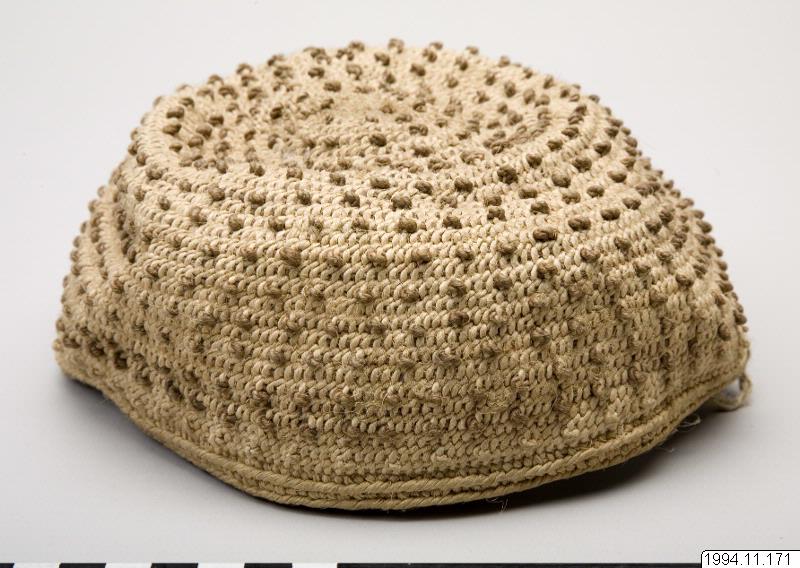


1994.11.0171
::
mössa

- Object description
En tvinnad mössa av, enligt listan till samlingen, ananasfibrer eller sisal. Gulgrå med bruna noppor. En liknande mössa från sundi i Kingoyi, Zaire finns avbildad på s 73 i Laman, 1953. Jämför också med mössan från Manianga på 1927.1.166 där det bl a uppges att den är ett "virknings"-arbete som är sytt med stoppnål över ett spröt.
"Bibudu. (Kinkenge m fl) Mössor av olika typer, som av gammalt bäres av hövdingar och andra vördiga personer. Dessa göra dem också vanligen själva. Som regel skulle slavar ej få bära huvudbonad och i allmänhet går folket barhuvat." Börrisson, 1925, s 59.
"If a girl put a cap on she was severely reprimanded, as she would then only be able to give birth to girl-babies. The men wear caps when drinking palm-wine because they are forbidden to drink without one. If a man has no cap and is unable to borrow one he must put a thread, a bit of bast or like on his head while drinking. A woman's head-band may also be used, but he must under all circumstances have his head protected in order not to be attacked or killed by the great minkisi. The medicine-men are therefore as a rule provided with caps. Influential chiefs, including females, use special headgear as a sign of dignity. ... The mpu or budu cap is made from pineapple or raffia-fibre and cotton. there are several different models of this." Laman, 1953, s 72.
 Important to know about the information in the online collection database
Leave a comment
Here you can leave a comment. You have to supply an e-mail, an alias and you have to accept the agreements.