

1953.21.0001
::
skulptur, figur

- Object description
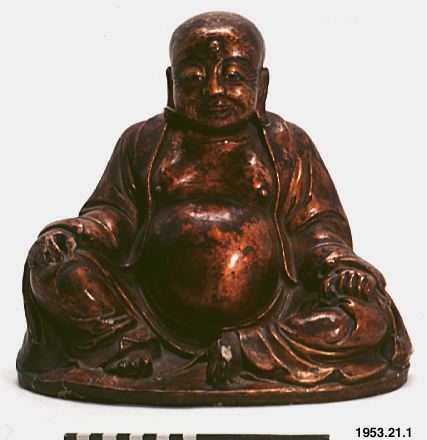
Gudabild av lackerad lera på stomme av trä, metalltråd mm. Föreställer pu-tai, som återges sittande på marken med bröst och svällande mage nakna. Som vanligt med ett förnöjt ansiktsuttryck. Urna i pannan samt utdragna örsnibbar.
S.k. guldlack täcker hela figuren. Under botten siden av 1700-talstyp. /Montell Generalkatalogen./
Pinyin bu dai, som betyder cotton bag, sack /Leijon/.
"Wooden statuette of the laughing Buddha. This image, and the other of a sitting very fat Pu-tai [means "hemline sack"], is one of the most attractive and popular Chinese motifs. Pu-tai was supposedly a 10th century CE monk who revealed himself as an incarnation of Maitreya, the Buddha to come [Mi-lo fo in Chinese]. Several Chinese ideals are embodied in the figure: the fat belly symbolizes wealth; his smile and relaxation indicate his equanimity, and the children around him show his love of children, one of the principal Chinese virtues. His eccentric actions also express the mind of Ch'an [zen] Buddhism.
In some temples we find Maitreya or his supposed incarnation the Pu-tai-ho shang, or Calico-bag (cushion) Monk. This monk is said to have lived in the sixth century A.D., but he was not honoured as a Lohan until modern times. He is the special patron of tobacco-sellers, and his jolly fat little image often adorns their shop-fronts. Another interesting person sometimes found among the Eighteen Lohan is the Indian Buddhist Dharmatara (or Dharmatrata), in Chinese.
"Priest cloth bag", also known as "The Laughing Buddha."
The sack contained endless treasures which he gave freely, characterizing his virtue of giving./Is
 Important to know about the information in the online collection database
Leave a comment
Here you can leave a comment. You have to supply an e-mail, an alias and you have to accept the agreements.