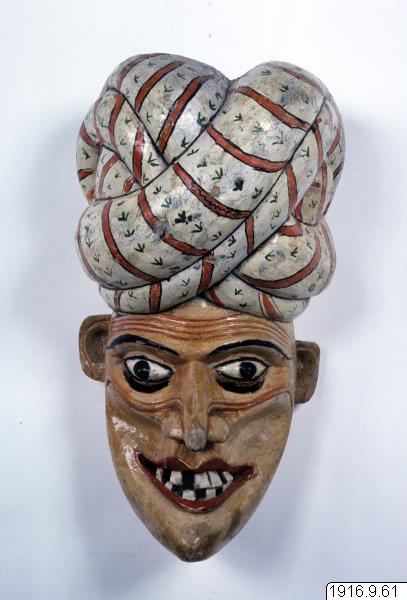
1916.9.61
Name and identification of character
Kolam mask depicting the moneylender, hettiya or hettirala (Sin.).
Context
The moneylender appears in a humorous episode in Kolam. He enters the arena with his local assistant called Väligampitiya.
Material
Wood, vel-kaduru (Sin.) (Nux vomica).
Iconography
The head-dress is broad and tall and elaborately folded. It is in the form of a turban worn especially by people of Indian origin. It should be differentiated from the turban worn by the drummers; the former is a talappava, which is an expression in Tamil, and the latter is called uramava (Sin.) or jatava (Sin.). Moreover, the turbans of drummers are firmly tied white cloths with dangling ends. The head-dress of the moneylender is taller and broader than that of the drummer. It has no loose ends, and is shaped like a bundle-pack.
The turban is painted in white (to suggest white cloth), and divided into folds with red and black lines. Crow-feet, kaka-pada (Sin,), designs are registered in green.
The face is painted in lemon yellow. Red wavy lines have been painted on the forehead and around the chin. These are suggestive of wrinkles. Deep grooves are noticeable on the cheeks.
The mask, while presenting the characteristics of a foreigner, chettiyar (Tamil) or hettiya (Sin.), is appealing as a fine example of caricature, which is a feature of traditional Sinhala mask-making. These traits along with colour combinations give the impression of a cunning and miserly man. The pointed nose in the form of a hawk's beak, the narrow and pointed chin, as also the wrinkles complete the picture of a moneylender. The penetrating eyes and the triumphant expression on his face are suggestive of the careful manner in which the moneylender surveys the customer before lending him the money. These details are fine examples of clever craftsmanship. The carver has shown his competence in digesting the familiar details of the character.
The turban reveals very sensitive carving. Although the turban and the face are carved out of one piece of wood, subtle carving convinces the onlooker that the turban is detachable. The moneylenders normally do not wear the turban during the entire transaction. They remove the turban and place it on the table once he is confident that the customer has accepted his conditions. A few white teeth carved at irregular intervals, set in a black and red coloured mouth, captures the half-grin of the moneylender.
Comments on the Umaluff Catalogue
The mask is identified as depicting ¿Sacre¿ (which is a phonetically incorrect rendering of Sakra) in the Umlauff Catalogue. Sakra, the chief of gods, appears as an old man in the story named Sanda-kinduru Kathava (Sin.). There is no separate mask to represent this character. The dancers are in the habit of using the mask of a drummer to represent Sakra. But the mask of the moneylender, with the turban and other sculptural details is not used in this context.
2000 05 08
Dr. M. H. Goonatilleka


Leave a comment
Here you can leave a comment. You have to supply an e-mail, an alias and you have to accept the agreements.