.jpg;jsessionid=bXp1QHc4Vj5ZRDU5jxcUVwOZi5c3tvV8JNPfGJ69.webcarl03)

Amathus - Swedish Cyprus Expedition (1927-1931) :: 1930-04
- Object description
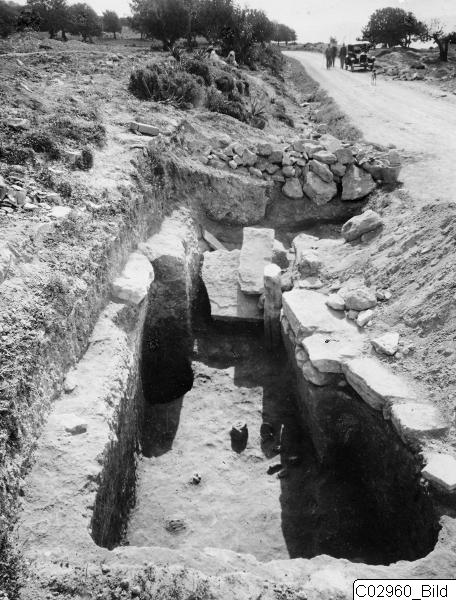
From April to May 1930 The Swedish Cyprus Expedition excavated a necropolis on both sides of Amathus'acropolis. Amathus was known and visited during the 18th century and 19th centuries by travelers and archaeologists. Earlier excavators, such as General Luigi Palma Di Cesnola, the first American consul in Cyprus, excavated the necropolis' large tombs situated north of the acropolis and the tombs in the necropolis west of the acropolis hill. Since he did not publish any plans or drawings John Lindros illustrated two of the tombs from the old excavations that were still possible to visit. The necropolis had partly been excavated by the English Expedition to Cyprus in 1893-94 and published in Excavations in Cyprus, London 1900. The Swedish Cyprus Expedition excavated around 25 tombs.
The tombs excavated are shaft tombs with a dromos, which are rather rare in Cyprus. Variations of the shaft tombs occur, mostly because of the various circumstances of space and economics as well as difficulties in cutting the rock. The archaeologist identified six different styles. It is the shape of the dromos that differs the most between the different styles. Tombs 1 and 2 differ from the others in the sense of construction and quality and might have been created for wealthier people, maybe royals. Tomb 3 is more reminiscent of the other graves found in Cyprus since it is a chamber tomb. Tomb no. 26 had a large tumulus and might have been related to other Hellenistic tumuli. It contained a stone pithos with an alabastron in which a burnt skeleton was found. Around the rim of the alabastron a wreath of gilded myrtle leaves was placed. The excavator thought it might have been a Ptolemaic official who died in Amathus and was buried according to a foreign burial custom.
Otherwise, the same burial customs were observed in most of the tombs. Many were reused multiple times, in which case the burial gifts were pushed into the corner of the tomb. Later, during the Hellenistic and Roman periods, Amathus was once again used for burial. These burials did not damage or alternate the earlier tombs since they were usually somewhere in the upper layers. The tombs are dated from the Cypro-Geometric I to the Roman period.
 Important to know about the information in the online collection database