
1930.21.0021
::
väska

- Object description
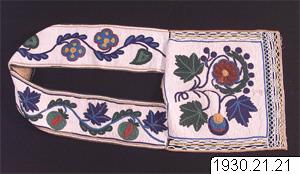
This bag in not actually used for carrying things. Bandoleer bags are most often made without any actual pocket or opening, and are traditionally used in dances and ceremonies. The bags are most often worn by men, and are most often the handiwork of talented craftswomen. The style of these bags come from the bandoleer belts worn by European colonists among the military.
Bandoleer bags can be gifts at give-away dances to honor and respect fellow band members. The flower pattern on the bag is very traditional in Anishinaabe bandoleer bag making. This pattern is somewhat simple compared to some designs and beadwork done on other bags of the time, yet it is no less beautiful. The size of the bag is not as long as some of later bags made, and this could be one reason to believe that the bag is from the last half of the 19th century.
The flower patterns can reflect the plant life from the ojibwe environment, but it often seems to be more creative than just reflections of natural surroundings. There are at least 2 sorts of flower patterns on this bag. The colors used in the patterns are based mainly on aestetics. Maple leaf or grape leaf designs are represented. Fruits are also abundant on the bag. Blueberries or grapes, and what looks like "green tomatoes" with the red pulp of the middle showing where it was sliced
through. Also, some other pattern that could be a fruit or a flower in four different colors.
A very common characteristic in Ojibwe beadwork is the "otter-tail" patterns found bordering the "bag" portion of object. There are three "otter-tail" patterns on the verticle sides of the bag in yellow and white sewn onto black velvet. The bottom portion of the bag in a horizontal direction has also 3 "otter-tail" patterns. The top one in light-blue and white as two parallel waving lines. The pattern under that is in white beads, two lines that cross each other in a chain-like pattern. The bottom pattern is one wavy line of beads in yellow.
Normally there are fringes that hang at the bottom of bandolier bags. It appears as though this bag once had such fringes, but they have been removed, and to my knowledge were removed before the bag came to the museum.
-NW
 Important to know about the information in the online collection database
Leave a comment
Here you can leave a comment. You have to supply an e-mail, an alias and you have to accept the agreements.