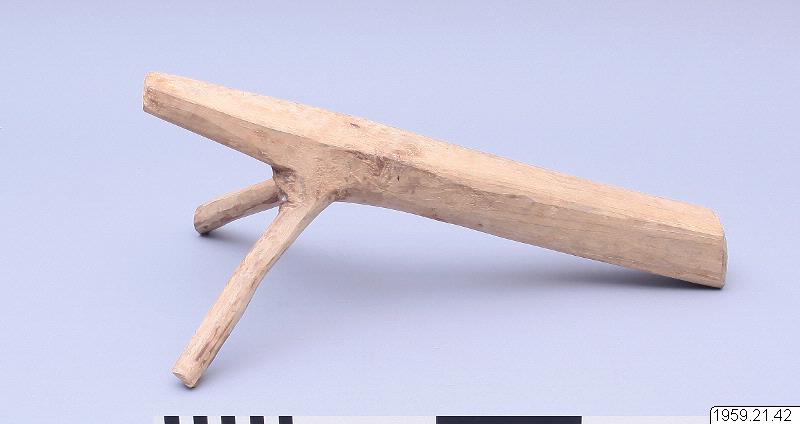

1959.21.0042
::
pall

- Object description
Pall i form av en trefot . Av trä, Skuren direkt ur trästammen, med två av grenarna kvar som fötter. Användes vid rivning av kokosnötsmassa. Ett rivjärn bindes vid den främre utskjutande delens översoda. En kokosskrapa av detta slag kallas av de infödda tuai.
Den snedställda sittstamens längd: 54 cm.
Litt.: P.H. Buck: Arts and crafts of the Cook Islands. (B.P. Bishop Museum, Bull. 79. Honolulu 1944.) P. 24: "The Mangaians did not use the four-legged seat in former times, but constructed their graters from small tree trunks with two branches at suitable angles to form front legs, or from large branches with two subsidiary branches..." Pp. 414f: "The rich creamy fluid wrung from grated coconut was used wherever coconuts grew. The simplest technique is to use a marine shell to scrape the flesh out in thin slices. This method was used in Hawaii and was an alternate method in Tongareva. A pearl-shell implement shaped like a shoehorn was used in Mangareva, Manihiki-Rakahanga, and Tongareva. The cracked nut was held on the lap vanced type of grater was the tripod grater formes from the trunk and two branches of a tree or a large bough with an attached grating element: a piece of coral, a marine shell, or shaped pieces of hard coconut shell....The tripod grater was used in the west in Samoa. It was probably introduced into the Cook Islands in the primary pperiod and displaced later by the four-legged stool grater, except in conservative Mangaia which retained the tripod grater. The stool grater is present in the Soceity and Austral Islands which also have the four-legged stool. It is signicifant that Mangaia, where the tripod form survived, did not have the fourlegged stool..." (katalogkort/originalbeskrivning)
 Important to know about the information in the online collection database
Leave a comment
Here you can leave a comment. You have to supply an e-mail, an alias and you have to accept the agreements.