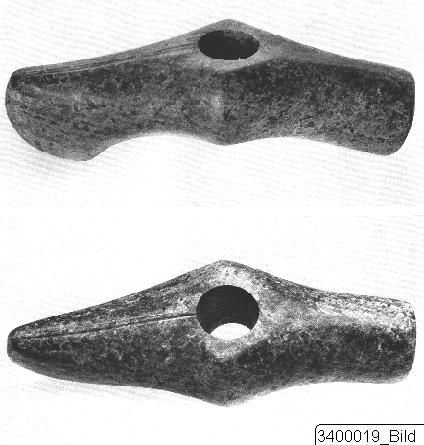

BEK 1964.11
::
axe

- Object description
- This implement may be a ceremonial battle-axe, as indicated by its well-preserved condition, fine workmanship and highly polished surface. It is half axe, half hammer and the longitudinals of both parts together form an obtuse angle. The axe has a flaring blade with the upper side facetted lengthwise, probably an imitation of the cast-seam of its metal counterparts. In the middle there is a well-drilled hole for the handle. Axes of this type have to a large extent been found in Troy. The most well known examples come from Schliemann’s Treasure from Troy II. It was discovered in 1890 near the center of the citadel and included four magnificent battle-axes; three made of nephrite and one of lapis lazuli. They are all well-polished and decorated with ridges and knobs in relief. Similar pieces have also been excavated in South Russia (Bessarabia, Borodino) and on the Greek mainland (Thessaly), which may exemplify the far-reaching commercial contacts in which Troy also participated. The type is further represented in East Anatolia (Alisar) by a fragment of a similar axe made of green stone. Typologically they all belong to a kind of a battle axe occurring from North Scandinavia to Switzerland, South Germany, Hungary, and South and Central Russia. The examples deriving from South and Central Russia may be intermediaries between the axes from the North and Asia Minor, but it seems more probable, however, that this type of battle-axe is characteristic of the Eastern Mediterranean. The axe was important in antiquity, in war, in the chase, as well as for domestic purposes. Making one was a rather complicated procedure with the simple instruments available – flint knives, sand and water. A suitable piece of stone was worked out with a hammer, and then sharpened and polished on a block of sandstone., and fastened onto a handle. The perforation, probably made before the final treatment, was drilled with a stick, sand and water. Since the occurrence of this kind of axe is most frequent in Troy, one may base the dating of this example on a comparison with its counterparts from that area. The type is represented once in Troy I and it is most probable that it was only exceptionally in use in the Mycenean period and later. The main part of the axes with a known find-context was, with a few exceptions, found in the layer of Troy II. This axe is therefore likely to derive from Asia Minor, possibly the area of Troy. Typologically it seems to belong to Troy II or circa 2500-2300 BC. Marie-Louise Winbladh
 Important to know about the information in the online collection database
Leave a comment
Here you can leave a comment. You have to supply an e-mail, an alias and you have to accept the agreements.