
1938.30.0114
::
lampa

- Object description
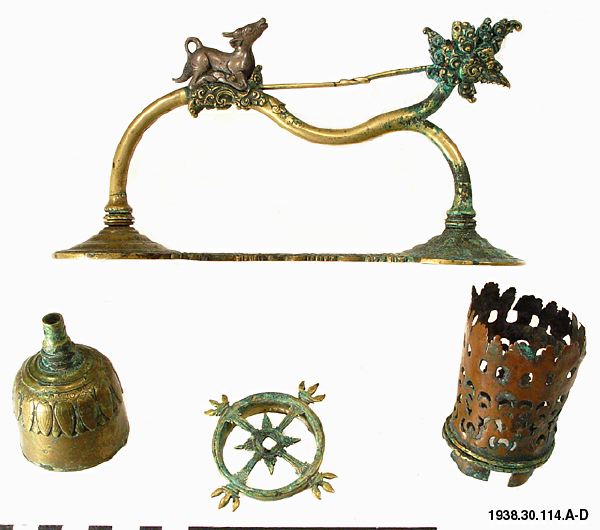
Oljelampa (padamaran) av brons.
"Lampa av brons. Står på två runda plattor som är förenade med ett brett genombrutet band,i vars mitt befinner sig den oupplösliga knuten, dekorativt utformad. Från plattornas mitt går ett rör i osymmetrisk båge som förenar dem. På bågens bakre del en ko av silver. Bågens främre del utgör fäste för ett rör som uppbär lampan. Vid detta rör ett garuda-huvud (Garuda är Wisnu's solfågel). Översta delen av lampan kan lyftas av varvid man ser Wisnu's vapen -Tjakre[sic!], som bildar ett galler över lampskålen. Denna fylles med olja. Heter Pedàmaran[sic!] och användes av prästerna. Pedanda är en brahmanpräst av högsta rangen." (Generalkatalogen)
Padamaran är ett av de typiska föremålen som förekommer vid den prästerliga ritualen.
"...the coppersmiths and copper casters of the Banjar Budaga in Klungkung worked for the open market. The main customers for their products, forged or cast out of brass or red brass, were priests of all categories, whose demands for cult objects and attributes could only be met by them.
The Hinduistic type of bell (ghanta) that accompanies the recitation of the mantras is numbered among the best known specialities of the copper casters of Klungkung. These bells have artfully decorated handles in the shape of Indra's thunderbolt (bajra), Wisnu's weapon (cakra), Siwa's bull, etc. The material for such bells generally came from fragments of the keys of old metallophones.
In Banjar Budaga, Brahmana priests of the Buddhistic (padanda boda) and Siwaite (padanda siwa) sects bought the lamps on two connected feet (padamaran) and the tripods (tripada) used as bases for round holy water containers (swamba) and incense burners (pasepan) that were all typical of their ritual. The feet of such pieces were often decorated with figures of lions (singha). The special attribute of the padanda boda, the thunderbolt bajra, was also produced here.
All these cult objects were for the most part made using the so-called lost wax technique. A model made of beeswax and exactly corresponding to the desired object was first covered with a mixture of clay, burnt bran and water. After this thin layer was dry, another layer, this time made of clay, was put on. When the cast, too, was dry, it could be heated over a fire until the wax flowed out through holes left for that purpose. Now the clay cast was fired. After it had cooled, liquefied metal could be poured into it. Finally the clay shell was smashed and the object appeared." (Ramseyer, Urs. 1977. s.66)
Andra föremål som ingår i den prästerliga ritualen i denna samling:
Skål (swamba), 1938.30.444
Kanna (kenceng, enligt Generalkatalogen), 1938.30.113
Kanna (kekenceng, enligt Generalkatalogen), 1938.30.120
Rökelseskål (pasepan), 1938.30.115
m.fl.
Skador:
Lampan har korroderat.
(NS)
 Important to know about the information in the online collection database
Leave a comment
Here you can leave a comment. You have to supply an e-mail, an alias and you have to accept the agreements.