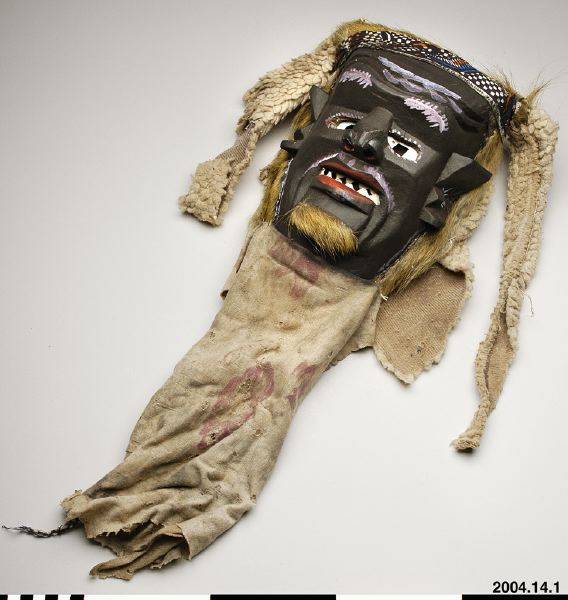

2004.14.0001
::
mask (ansiktsmask)

- Object description
Svart/brunmålat ansikte med grova och kantiga former. Djupa fåror i pannan. Vita tänder och ögonvitor i utklippt papper. Hår av päls (get, katt, apa?)fästs i pannan under tygremsa i vitt, svart , rött och blått, längst ned i kanten av detta tygstycke kan man läsa "Guranteed English Wax". Även hår längs käklinjen på båda sidor av ansiktet samt i ett litet hakskägg. Tyg i "teddy" variant fäst på sidorna och runt om huvudet, hänger ned under hakan. Ljust lila markeringar syns i pannan, som ögonbryn, ögonfransar och mustasch, under underläppen, runt käklinjen samt som streck runt båda öroningångarna.
Det är en sk Nyau mask från Chewafolket som bor i Mozambique, Zimbabwe, Malawi och i angränsande delar av Zambia.
Chewa-specialisten Dr. John M. Peffer, Art History Department,
Northwestern University, skriver i en e-post efter att ha sett ett fotografi av masken: From a quick look your mask seems to be of very recent make, possibly from the central "Chewa" region around Lilongwe. From the black/brown color and from what looks like cat hair on the chin and head, it looks like a general chief portrait mask type called Chadzunda. For related masks see Laurel Birch de Aguilar Inscribing the Mask University Press Fribourg Switzerland, 1996, pages 270 and 271.
Professor Peter Probst, Department of Art and Art History vid Tufts University skriver om masken i ett e-mail:
"As you might know Nyau is a highly fragmented complex and you have different versions of it in Zambia, Zimbabwe, Mozambique and Malawi.
Personally, I have learnt to become highly sceptical of any fixed typology and classification. Often the names of the masks change, in fact, one mask can have several names and meanings depending on the context in which it performs. Nevertheless, black anthropomorphic maks are somewhat special and I would guess what you have is a Nyau mask which goes by the name "Chadzunda", in this case usually translated as "chief" or a person of chiefly authority.
Chadzunda appears at burial ceremonies when Nyau (masks) come to the village to claim the spirit of the deceased. Accordingly, the black face ties the mask to the realm of death and the grave. In addition, Chadzunda dances in remembrance of deceased chiefs which explains the naturalistic style of these masks. Often their are carved in likeness of chiefs. A common figure often seen together with Chadzunda is Maria, a female figure, which represents the female gender as Chadzunda's wife. Keep in mind, however, that Maria just as many of the other anthropomorphic masks can perform numerous role. Only matured members of nyau are allowed to dance Chadzunda.
In the Zambian context, particularly in urban environments like Lusaka, nyau is often danced merely for entertainment, which might explain the somewhat folkloristic appearence of the mask. Nevertheless, despite their semi-secular function, the masks still carry ritual importance, so the story you are refering to truly makes sense."
Laurel Birch de Aguilar skriver i sin bok(sid.141) om maskernas komplexa identitet och hur deras livshistoria hela tiden förändras:
"Once the mask is sold, the mask acquires other identifications which may not have been intended by the carver. The mask history becomes intertwined with the history of individual owners, dancers, performance events and communities. As the mask is danced over and again, the mask becomes recognized by whole communities in ways unforeseen by the carver who created it. The lives of the people who create, own and dance the mask are inextricably tied to the life history of the mask, which is tied to the experiences of communities of people and the masked events".
Leave a comment
Here you can leave a comment. You have to supply an e-mail, an alias and you have to accept the agreements.