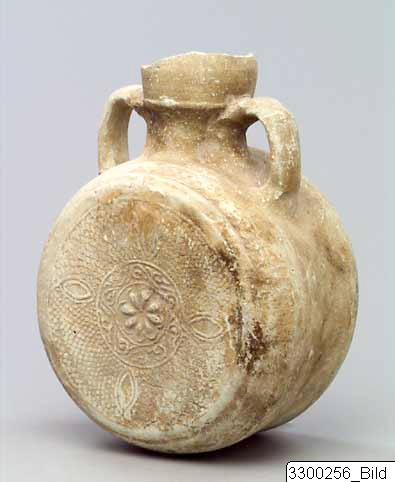
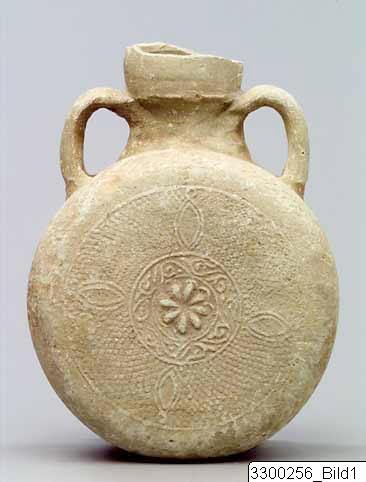
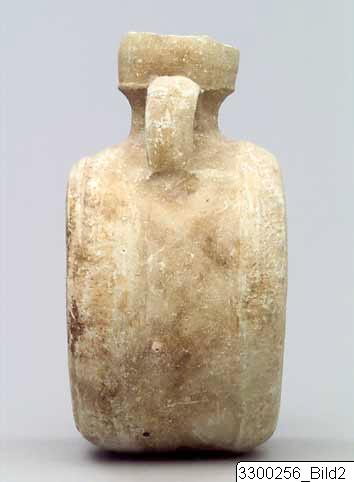
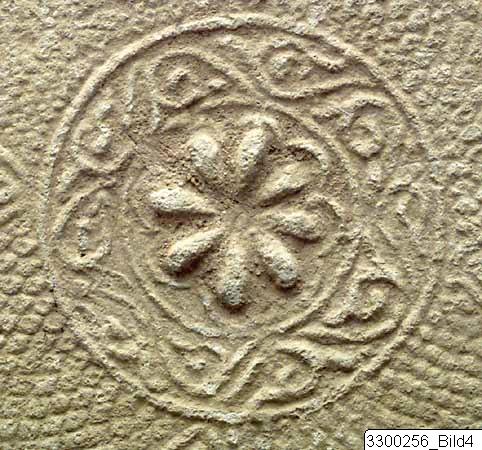
The heavy, pinkish-grey earthenware flask belongs to the group of the so-called pilgrim bottles. The body of this type of pilgrim bottle is commonly composed of two flat circular sides, each with a broad, flanged edge and an unornamented strip of earthenware in the middle connecting the two side parts. This connecting strip is slightly concave so that the flask stands in a safe upright position on the edges of the side parts. Above, the bottle has a flared neck consisting of two sections separated by a ring in relief. The rim of the neck is damaged. For carrying and suspension, there are two handles fixed to the neck and to the shoulders. The bottle shows identical moulded decoration on both sides. At the centre there is an eight-petalled rosette surrounded by an arabesque scroll. The four double-framed leaf forms of the outer zone are set against a dense background pattern of tiny rhombs.
On similar bottles the centre of the sides often bears an emblem easily recognised as belonging to one of the Ayyubid or Mamluk sultans and amirs. These emblems were attributes of their dignity. A rosette might not appear to be a specific emblem but it does actually belong to them. It is actually one of the oldest devices used under the Ayyubids and early Mamluks. They usually chose six-petalled rosettes. Only one amir, Musa bin Yaghmur (AH 599–663 / AD 1203–65), seems to be known whose emblem was a white eight-petalled rosette as seen on this bottle. He was governor of Cairo under the Ayyubid al-Malik al-Salih and in AH 648 / AD 1250 under al-Malik al-Mu'azzam governor of Damascus.
Judging by the unglazed body, this bottle could have been used for storing liquids such as water. The porous material allowed evaporation to keep the liquid stored in it cool.
Source: [https://islamicart.museumwnf.org/database_item.php?id=object;ISL;se;Mus01;13;en&cp]
How date and origin were established:
An Ayyubid amir, Musa bin Yaghmur (599–663 / 1203–65), is known to have as an emblem the eight-petalled rosette without shield.
How Object was obtained:
Gift of the Swedish Crown Prince Gustaf Adolf in 1935.
How provenance was established:
There are different clues. Musa bin Yaghmur to whom the bottle may be ascribed was governor of Damascus. Other pilgrim bottles of this type come from Syria and Jordan. This bottle is supposed to have been excavated, probably in Syria, since it was bought by the Swedish Crown Prince in Aleppo.
Source: [https://islamicart.museumwnf.org/database_item.php?id=object;ISL;se;Mus01;13;en&cp]



Leave a comment
Here you can leave a comment. You have to supply an e-mail, an alias and you have to accept the agreements.