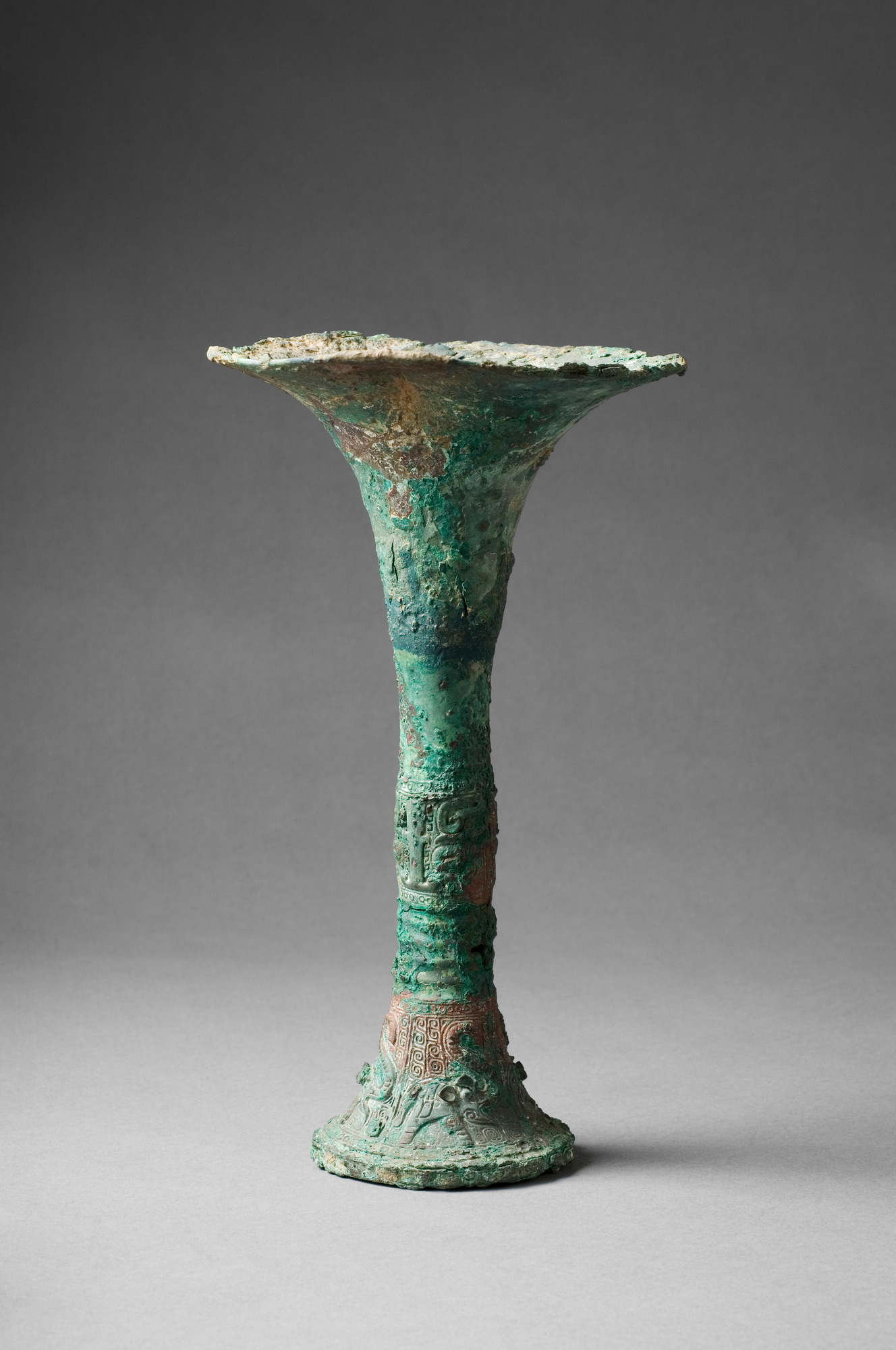
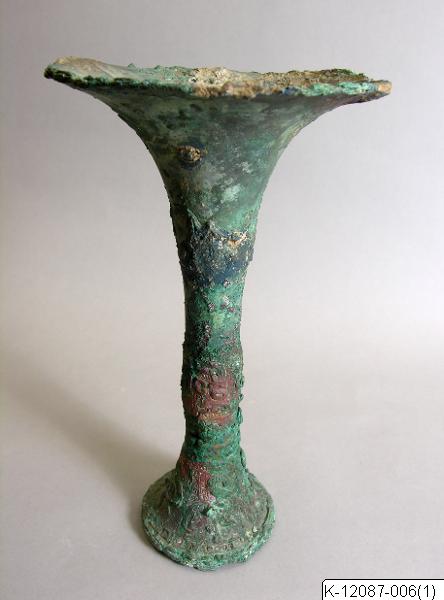
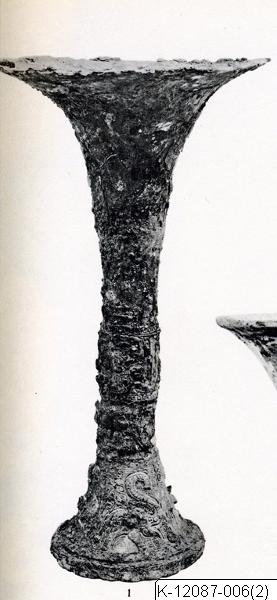
Gu - trumpet-shaped wine beaker for sacrificial use. Bronze. Narrow central section and wide, flaring lip. Two cross-shaped holes.
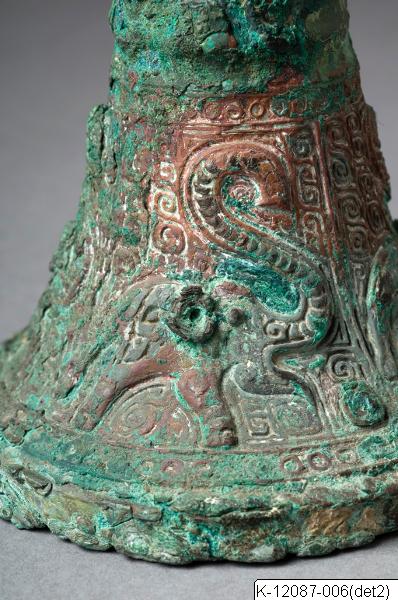
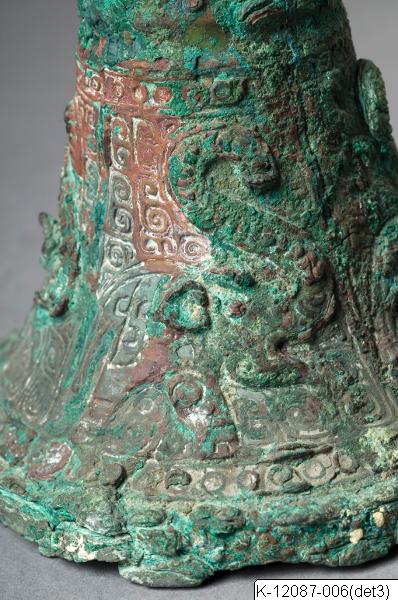
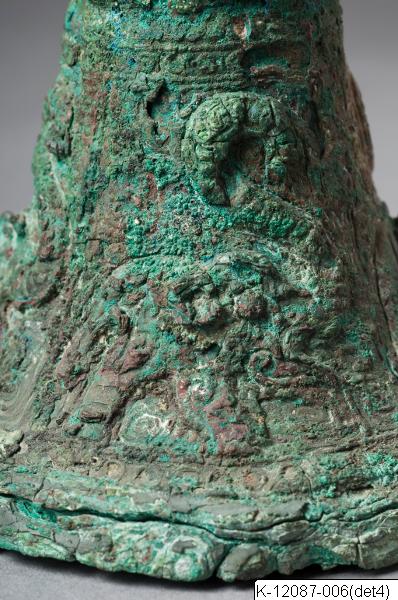
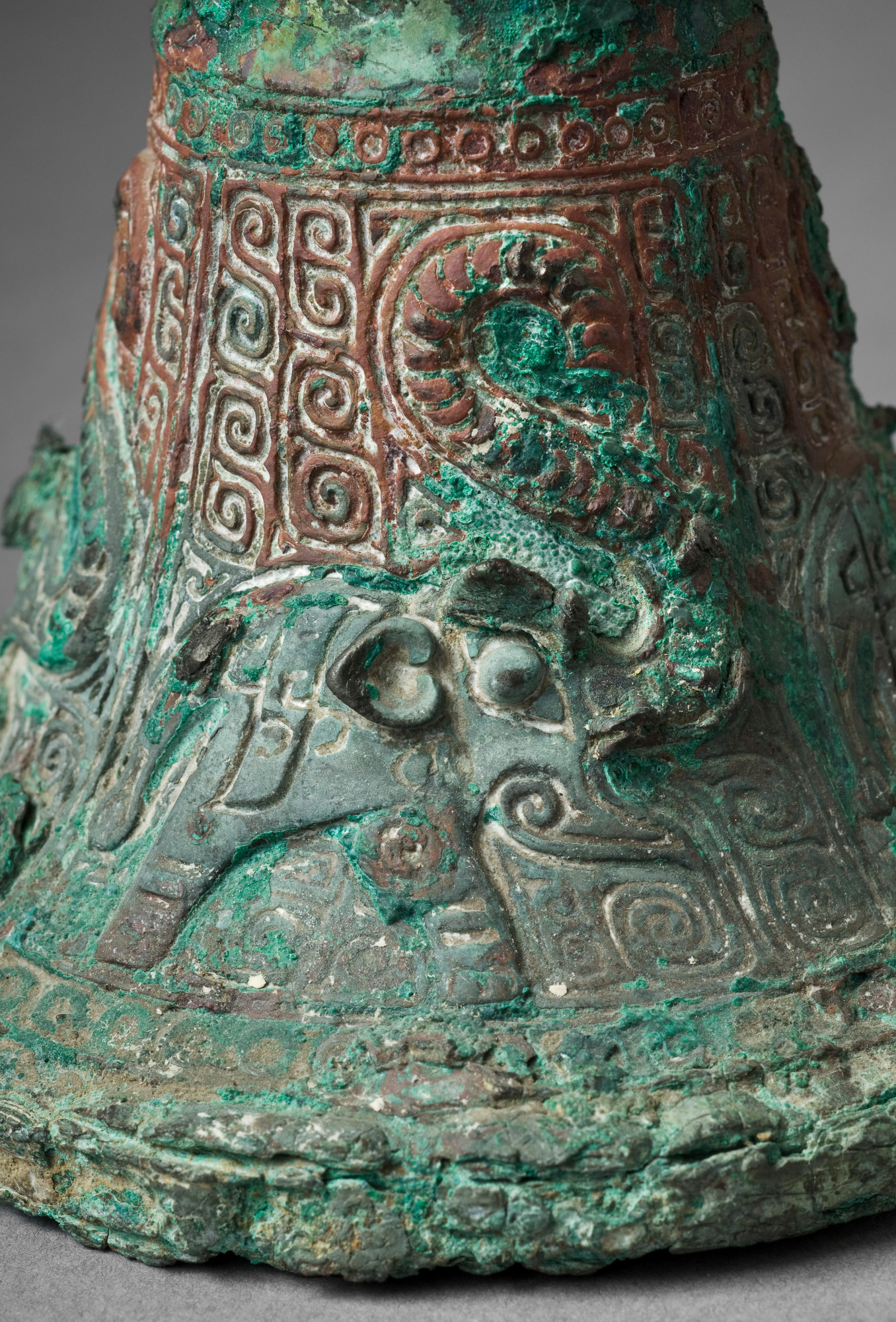
The middle part of the gu is decorated with a belt of dissolved taotie-masks with tiny ridges. The foot is decorated with a belt of three elephants with open mouths and raised trunks, their ear flaps being raised from the background. The elephants are depicted in relief against a background of "cloud and thunder" pattern (yunleiwen). The two décor belts are bordered by bands of circlets.
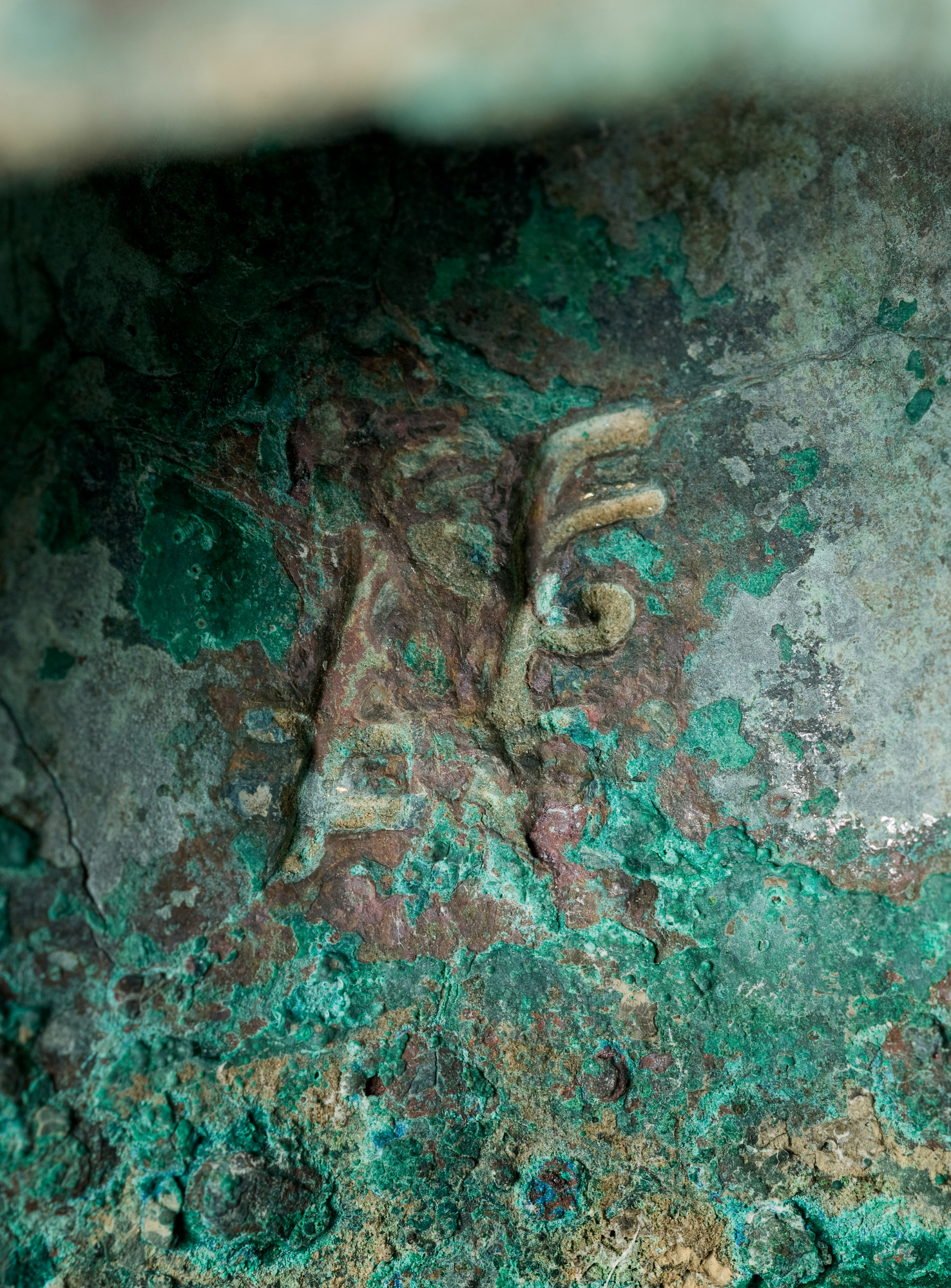
Inscription under the foot: Bing 并(clan name)
Shang, Anyang period
Dark green patina, heavy incrustations.
This gu belongs to a set of bronzes which has been traced together by Li Xueqin & Sarah Allan (Ouzhou suocang Zhongguo qingtongqi yizhu, Peking 1995, no 15 and 29):
The set includes three gu vessels with the same pattern of marching elephants: In addition to the one in Stockholm, there is one gu in the Idemitsu Museum, Tokyo, and one gu in the collection of the dealer Christian Deydier in London. B. Karlgren mentions a gu of the same type in the collection of C.T. Loo (BMFEA, vol. 21, p. 7), this might be idetical with the Deidier gu.
There are also two gui-vesssels, each decorated with nine elephants of the same type, one ine Ostasiatische Museum in Cologne, and one in the Palace Museum, Peking. The Palace Museum gui was published in Wenwu 1973:12 (Du Naisong, “Ji jiuxiancun yi sishe fangyan”, Wenwu, 1973:12, pp. 62-63) as a zun 尊vessel.
The Gugong-gui and the Stockholm gu are both inscribed with the same character Bing 并(clan name)



Leave a comment
Here you can leave a comment. You have to supply an e-mail, an alias and you have to approve the conditions.