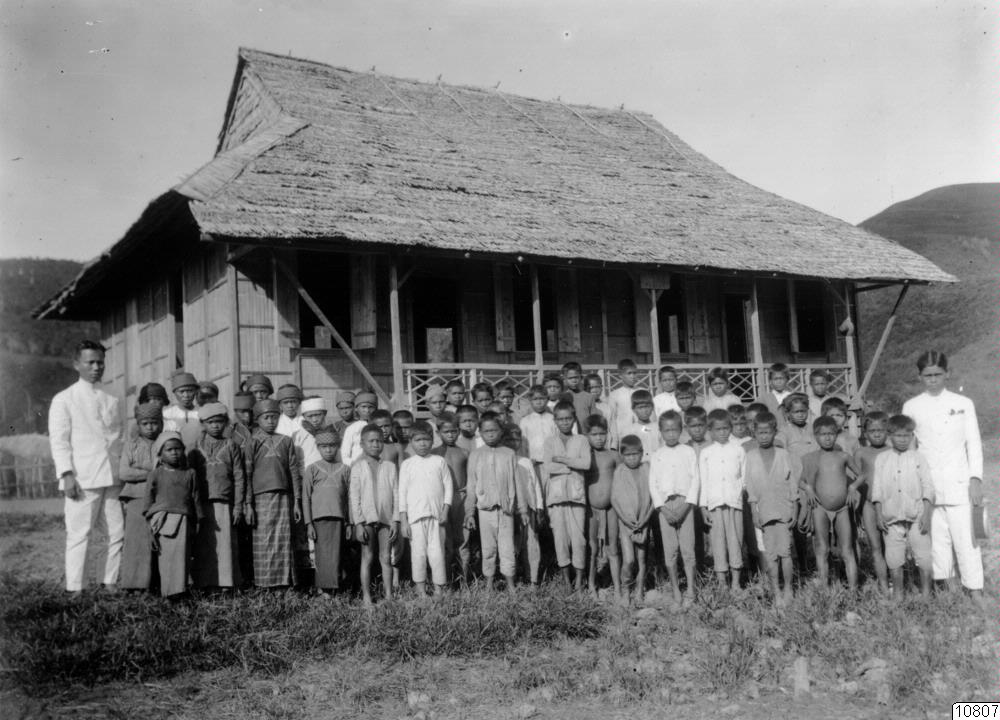
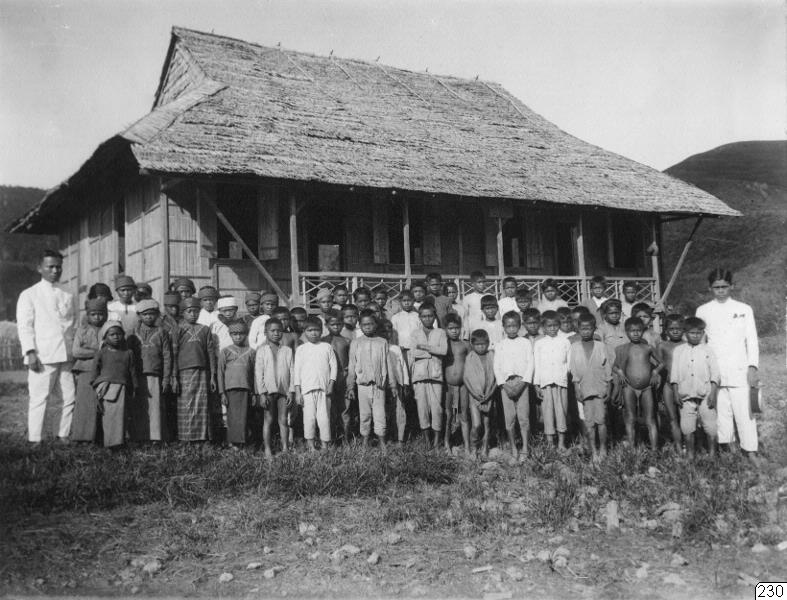
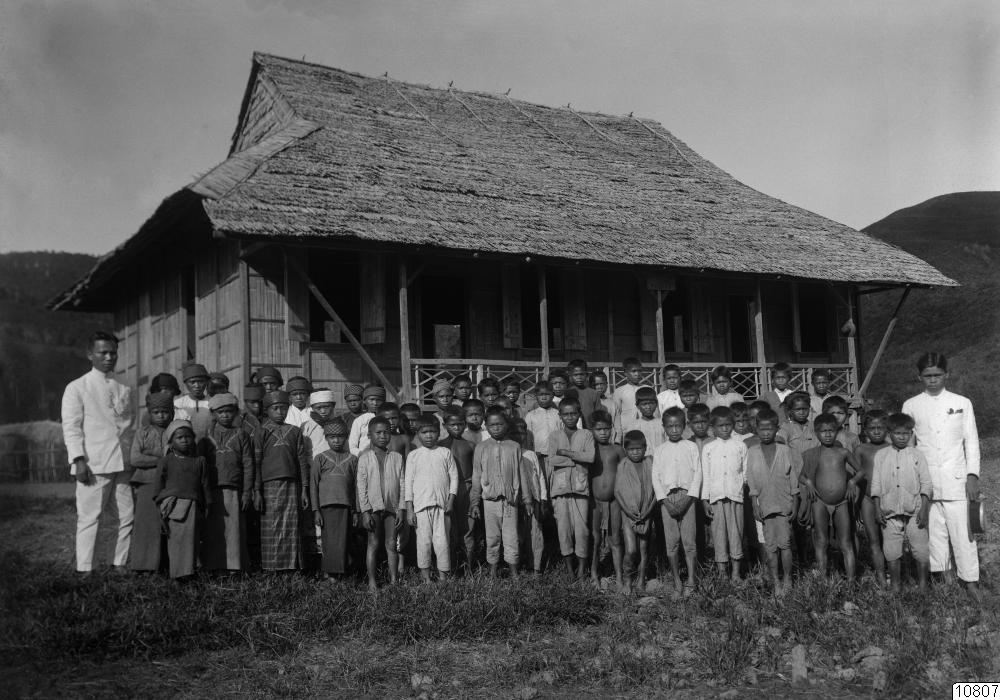
Det här är eleverna och lärarna i skolan i Taripa, huvudort i regionen Ondae
i Sulawesi, Indonesien. Bilden är tagen i juni 1919. Läraren till vänster kommer från
Minhasaprovinsen på nordkusten, ett område som varit under holländskt styre sedan
1693. Läraren till höger kommer liksom eleverna från Taripa. Vi känner inte till
deras namn. De yngre i Taripa talade malay, det språk som sedan 1500-talet varit
gemensamt för Sydostasiens övärld.
Byn var byggd helt enligt myndigheternas mall. För att kontrollera området flyttade
holländarna mängder av byar och förbjöd många viktiga ritualer mellan 1906 och 1908.
Holländarna ville komma åt landets guldtillgångar innan de andra kolonialmakterna
hann före. Detta legitimerade de med frälsning och mission och sa att det var för
folkens eget bästa. För att byborna skulle klara självständighet sades det att de var
tvungna att gå i holländarnas skolor. Missionen pågick länge i Taripa och fick stort
inflytande. Bland annat var missionärerna mycket stolta över att de fått de yngre
byborna att sluta tugga betelnöt och att de därmed fått vita och vackra tänder. (Ögonblickar 2013, utställningstext)
This is the pupils and teachers of the school in Taripa, the main town in the Ondae
region, in Sulawesi, Indonesia. The photograph is taken in June, 1919. The teacher
to the left comes from the Minhasa province on the northern coast, a region that has
been under Dutch rule since 1693. The teacher to the right come from Taripa, as do
the pupils. We do not know their names. The young of Taripa spoke malay,
the language that since the 16th century have been common in the South East
Asian islands.
The village was built according to the colonial instructions. To control the area a lot of
villages were moved in the period between 1906 and 1908, and many important rituals
were banned.
The Dutch wanted to get to the gold resources ahead of the other colonial powers.
The colonization was legitimized as a salvific mission, for the good of the local people.
In order to learn how to cope with liberty the villagers needed to go to Dutch schools,
it was claimed. The mission in Taripa had a long continuation and impact.
The missionaries took great pride in the fact that the young had abandoned
the practice of chewing betel and therefore hade white and beautiful teeth. (Eye momonts 2013, caption)



Leave a comment
Here you can leave a comment. You have to supply an e-mail, an alias and you have to accept the agreements.